
Automakers love adding technology to new vehicles, but a bigger screen, another app or one more digital feature doesn’t necessarily make drivers want the car.
A new 2026 study of more than 10,000 U.S. vehicle owners provides an unusually good look at the car features buyers actually want, and some of the results may surprise anyone shopping for a new vehicle.
Safety technology remains extremely popular. Meanwhile, some features automakers have spent years putting into dashboards are actually losing momentum.
And younger buyers are increasingly choosing vehicles based on technology almost as much as they might choose a new phone. The Harris Poll
Blind-Spot Alerts Are the Feature Drivers Want Most
Sometimes the useful technology wins.
According to The Harris Poll’s 2026 AutoTECHCAST study, blind-spot alerts were the most desired driver-assistance alert feature, selected by 42% of respondents. The Harris Poll
That’s ahead of other safety alerts including forward-collision warnings.
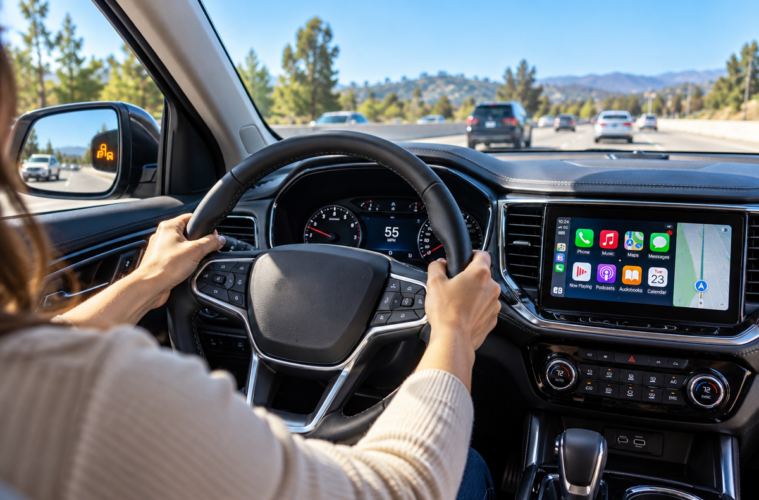
Blind-spot monitoring is relatively simple from the driver’s perspective. Sensors watch areas beside and behind the vehicle that can be difficult to see, and a warning usually appears in or near the side mirror when another vehicle is detected.
There’s no complicated menu to navigate and very little for the driver to learn.
It simply helps solve a real driving problem.
Buyers Still Want Technology, Just Not Technology for Its Own Sake
It’s easy to assume drivers are tired of vehicle technology altogether.
The data suggests something more complicated.
Technology is becoming increasingly important when people choose which vehicle to buy.
Among Gen Z and millennial owners surveyed, 78% said in-car technology played a large role in choosing their current vehicle. That’s up 20 percentage points compared with 2016. The Harris Poll
Gen X came in at 63%, while 44% of boomers said the same.
Technology is also affecting whether owners return to the same manufacturer.
Seventy-nine percent of Gen Z and millennial respondents said their vehicle’s technology makes them more likely to buy from the same brand again. The Harris Poll
So buyers aren’t rejecting car technology.
They’re becoming more selective about which technology is actually useful.
Built-In Navigation Is Losing Some of Its Appeal
Here’s one feature automakers may want to reconsider.
The Harris Poll found that built-in media and navigation functionality had the steepest decline in momentum among the technologies it tracked in 2026. The Harris Poll
There’s an obvious possible explanation.
Many drivers already have navigation on their phones.
Apple CarPlay and Android Auto can put familiar navigation apps directly onto the vehicle’s display, allowing drivers to use services they’re already comfortable with rather than learning another manufacturer-specific system.
That doesn’t make factory navigation useless, particularly when it is integrated with other vehicle functions.
But it does raise an important question when you’re shopping:
Are you paying extra for something your phone already does?
Factory Dashcams Aren’t Winning Everyone Over Either
Dashcams are useful. A factory-installed dashcam sounds even better.
Apparently, buyers aren’t universally convinced.
Factory-installed dashcams were another technology showing declining momentum in the 2026 AutoTECHCAST results. The Harris Poll
Aftermarket dashcams are relatively inexpensive, easily replaceable and can move with you when you sell your vehicle.
A factory system needs to provide a meaningful advantage if an automaker expects buyers to pay considerably more for it.
This is worth remembering when you’re staring at a long list of optional equipment at a dealership.
“Built in” doesn’t automatically mean “better.”
Giant Passenger Screens May Be Solving a Problem Nobody Had
Another recent owner study reached a similar conclusion about flashy automotive technology.
J.D. Power surveyed more than 68,000 owners of new 2026 model-year vehicles and found that some of the highest-rated technologies were features that worked quietly in the background.
Passenger display screens performed much worse.
More than one-third of owners with a dedicated passenger screen said they had never used it, according to reporting on the study. Only 6% said they used the passenger screen every time they drove. The Verge
That’s worth thinking about when a dashboard covered in screens makes a vehicle look impressively futuristic in the showroom.
The novelty may last considerably less time than the car loan.
What Technology Is Gaining Interest?
Not everything new is being rejected.
The Harris Poll identified several technologies gaining momentum in 2026.
Among them were:
- Fully self-driving vehicle technology
- Extended-range electric powertrains
- In-car payment systems
- Panoramic displays
- Smart-home integration The Harris Poll
Extended-range electric vehicles are particularly interesting.
These vehicles generally use electric motors for propulsion but incorporate a gasoline engine that can generate electricity, addressing one of the biggest concerns surrounding pure EVs: driving range and charging availability.
Consumer interest doesn’t guarantee that every one of these technologies will become mainstream.
But it does show where buyer curiosity is moving.
Younger and Older Buyers Don’t Want Exactly the Same Things
One of the more interesting findings is that priorities change depending on age.
Blind-spot alerts were popular across generations, but different groups showed stronger-than-average interest in different safety technologies.
Gen Z respondents showed particularly strong interest in hands-on-wheel reminders, while boomers showed stronger interest in lane-departure alerts. The Haris Poll
Younger buyers are also becoming significantly more interested in electrification and connected-car technology.
Between 2023 and 2026, Gen Z interest increased substantially in battery-electric powertrains, vehicle-to-vehicle communication, EV route planning and vehicle cybersecurity. The Harris Poll
That’s important because the vehicles automakers design today need to remain appealing years from now.
Don’t Pay for Technology Just Because It’s on the Window Sticker
For shoppers, there’s a practical lesson here.
Before paying thousands of dollars for a higher trim or technology package, ask yourself how often you’ll actually use each feature.
Features that may be worth prioritizing include technology that improves:
- Visibility
- Collision avoidance
- Parking
- Everyday convenience
- Phone integration
- Driver comfort
Be more skeptical of expensive features that mostly duplicate something you already own or that you can’t imagine using regularly.
A feature can look impressive during a 15-minute test drive and become completely irrelevant after six months of ownership.
Test the Technology During Your Test Drive
People often spend a test drive concentrating almost entirely on acceleration, braking and ride quality.
Those things matter.
But if you’re going to live with a vehicle for five or ten years, spend some time testing the technology too.
Connect your phone.
Try Apple CarPlay or Android Auto.
Adjust the climate controls.
Change the radio station.
Enter a destination.
Turn on the heated seats.
Try the parking cameras.
See whether you can perform basic functions without digging through three touchscreen menus.
The best automotive technology shouldn’t require a tutorial every time you want to change the temperature.
Recommended Products
Check this out on Amazon – Wireless CarPlay Adapter
Check this out on Amazon – 4K Dash Cam
Check this out on Amazon – MagSafe Car Phone Mount
Final Thoughts
The 2026 data suggests drivers aren’t asking automakers to stop putting technology in cars.
They’re asking for better technology.
Blind-spot alerts remain highly desirable because they solve an obvious problem. Meanwhile, interest in some built-in navigation and factory dashcam technology is losing momentum as drivers gain easier alternatives. The Harris Poll
At the same time, emerging technologies such as extended-range electric powertrains and more advanced automation are gaining interest.
For anyone buying a car, the takeaway is simple: don’t judge a vehicle by the length of its feature list.
Pay for the technology you’ll actually use.
Disclosure: This article may contain affiliate links. If you purchase through these links, MotorReview may earn a commission at no additional cost to you.