
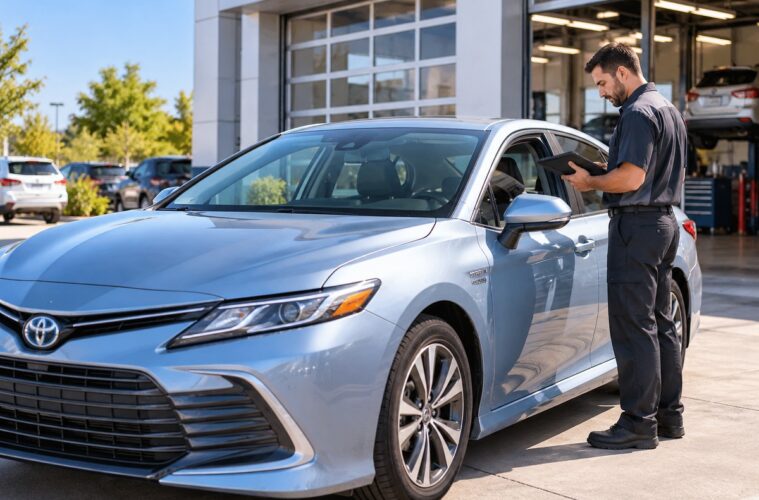
Buying a used hybrid in 2026 can be a smart way to save money on fuel without paying new-car prices. But shopping for a hybrid is a little different from shopping for a traditional gasoline-powered vehicle.
Along with the engine, transmission and ordinary maintenance history, buyers need to consider the hybrid battery, electrical components and warranty coverage.
The good news is that a used hybrid doesn’t automatically become a bad investment just because it has some mileage on it.
The key is knowing what to check before handing over your money.
1. Find Out How Healthy the Hybrid Battery Is
The high-voltage battery is one of the most important components in a hybrid vehicle.
Unlike the smaller 12-volt battery used to power accessories and support vehicle electronics, the hybrid battery stores energy used by the electric drive system.
Over time, batteries can lose some capacity. That doesn’t necessarily mean they’re defective, but it does make battery condition important when purchasing an older vehicle.
Before buying, ask whether the battery has ever been replaced, repaired or diagnosed.
Ideally, have a qualified hybrid technician evaluate the battery using manufacturer-compatible diagnostic equipment.
A dashboard without warning lights is reassuring, but it isn’t a substitute for a proper inspection.
2. Check How Much Battery Warranty Is Left
One of the biggest mistakes used-hybrid buyers make is assuming the battery is either completely covered or completely out of warranty.
The truth depends on the manufacturer, model year, mileage, location and vehicle history.
Some hybrids have lengthy high-voltage battery warranties, but coverage terms differ. Certain vehicles originally sold in states with stricter emissions requirements may have additional coverage.
Before purchasing, use the VIN to confirm:
- The original hybrid battery warranty
- Whether that coverage transfers to subsequent owners
- The warranty’s mileage and time limits
- Whether any replacement battery has separate coverage
- Whether the vehicle’s history affects eligibility
Get confirmation from the manufacturer or an authorized dealership rather than relying on the seller’s description.
3. Don’t Assume Every Hybrid Works the Same Way
A conventional hybrid and a plug-in hybrid are not interchangeable.
A conventional hybrid, such as a typical Toyota Prius or Honda Accord Hybrid, uses its gasoline engine and regenerative braking to recharge its battery during normal driving.
A plug-in hybrid, or PHEV, has a battery that can also be charged from an external power source.
That distinction matters when shopping used.
If you’re considering a plug-in hybrid, find out how much electric-only range remains, whether the charging equipment is included and whether you have a convenient place to charge it.
A PHEV that rarely gets plugged in may not deliver the savings you expected.
4. Review the Maintenance Records Carefully
Hybrids still have gasoline engines, cooling systems, brakes, tires and suspension components that require maintenance.
The presence of an electric motor doesn’t eliminate ordinary vehicle upkeep.
Look for records of:
- Oil and filter changes
- Engine coolant service
- Brake inspections
- Transmission or transaxle service when required
- Tire replacements
- Manufacturer-recommended hybrid-system maintenance
Pay particular attention to whether the previous owner followed the maintenance schedule for that exact model.
Some hybrid vehicles also have battery cooling vents or filters that require inspection or cleaning.
A vehicle with complete maintenance records is generally easier to evaluate than one with a mysterious service history.
5. Pay Attention to How the Hybrid Drives
A used hybrid should operate smoothly when transitioning between electric power and the gasoline engine.
During your test drive, pay attention to unusual vibrations, hesitation, warning messages or harsh changes in power delivery.
Test the vehicle in several conditions:
- Stop-and-go traffic
- Moderate acceleration
- Highway speeds
- Parking and low-speed maneuvering
- Hills, when practical
Some changes in engine speed or sound are normal for hybrids, particularly vehicles with continuously variable transmissions.
What matters is understanding what’s normal for the specific model you’re considering.
If something feels unusual, have a qualified technician investigate before buying.
6. Research Common Problems for That Model Year
Not every hybrid model has the same reliability history.
Even vehicles with strong reputations can have model-year-specific problems involving cooling systems, inverters, electronics or other components.
Before making an offer, research the exact year, model and powertrain.
Look for recurring owner complaints, manufacturer service bulletins and known repair concerns.
Also check the vehicle’s VIN using the NHTSA recall lookup.
A recall doesn’t automatically mean a vehicle is a bad purchase, but any outstanding safety repairs should be addressed.
The important distinction is between a well-maintained used hybrid with an understood repair history and one with unresolved problems that could become expensive.
7. Get a Pre-Purchase Inspection From Someone Who Knows Hybrids
This may be the single most valuable step in the process.
The Federal Trade Commission recommends getting an independent mechanical inspection before buying a used vehicle, even if the dealership says it has already inspected the car.
For a hybrid, choose a shop familiar with the specific manufacturer’s hybrid system.
Ask the technician to inspect the ordinary mechanical components and evaluate the hybrid system, including diagnostic trouble codes and battery-related data where available.
Get a written report documenting problems and estimated repair costs.
A vehicle history report is useful, but it cannot tell you everything about the car’s current mechanical condition.
And don’t attempt to inspect or repair high-voltage components yourself. Those systems require appropriate training and safety equipment.
8. Calculate the Real Cost Before You Buy
A used hybrid’s asking price is only part of the equation.
Consider the total cost of ownership, including:
- Purchase price
- Insurance premiums
- Fuel economy
- Expected annual mileage
- Routine maintenance
- Potential repairs
- Remaining warranty coverage
For example, a hybrid that saves you hundreds of dollars in fuel annually may be appealing. But a vehicle with unresolved mechanical issues could erase those savings quickly.
Compare the hybrid against a similarly priced gasoline-powered alternative.
Consider how much you actually drive and whether the fuel savings justify any difference in purchase price.
Should You Avoid a Used Hybrid With High Mileage?
Not necessarily.
Mileage is one factor, but maintenance history, age, battery condition and overall vehicle condition can be just as important.
A higher-mileage hybrid with detailed service records and a clean inspection may be a better purchase than a lower-mileage example that has been neglected.
Don’t judge the vehicle solely by the odometer.
What About Used Hybrid Battery Replacement Costs?
Battery replacement costs vary significantly depending on the vehicle.
A small conventional hybrid battery can be very different from the larger battery found in a plug-in hybrid.
Costs also depend on whether the replacement is new, remanufactured or refurbished, and whether the work is performed by a dealership or qualified independent shop.
Instead of assuming a universal replacement price, get an estimate for the exact vehicle you’re considering.
Ask whether the quoted repair includes parts, labor, programming and a replacement warranty.
Recommended Products
Check this out on Amazon – OBD2 Diagnostic Scanner
Check this out on Amazon – Digital Tire Tread Depth Gauge
Check this out on Amazon – Portable Tire Inflator
Final Thoughts
Buying a used hybrid in 2026 doesn’t have to be complicated, but it does require a little more homework.
Battery condition, remaining warranty coverage and a thorough inspection are especially important.
The smartest purchase isn’t necessarily the cheapest hybrid on the lot or the one with the fewest miles.
It’s the vehicle with a documented history, a healthy hybrid system and a price that makes sense for your driving needs.
Before signing anything, spend the money on a proper inspection. It could save you from a repair bill that makes those fuel savings disappear.
Disclosure: This article may contain affiliate links. If you purchase through these links, MotorReview may earn a commission at no additional cost to you.